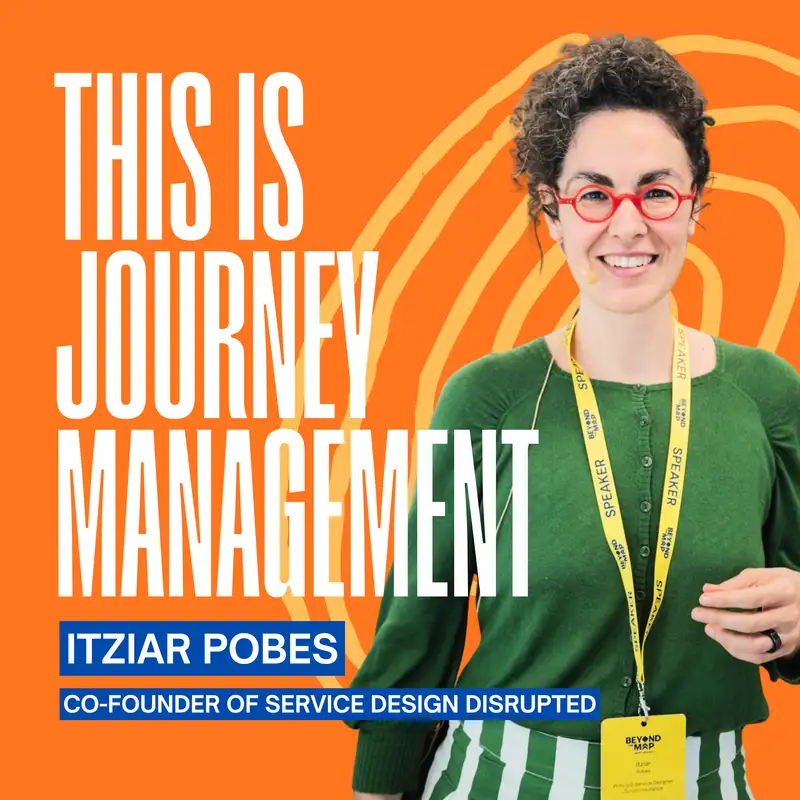
Maps Were Always Useful: 15 Years of Journey Maps, with Itziar Pobes
[00:00:00] Marc Stickdorn: Welcome to This is Journey Management. I'm Marc Stickdorn. There's a story going around that journey maps were not useful until there was journey management. My guest today is Itziar Pobes, doing service design for 15 plus years. In today's episode, we are going to look at some artefacts, some journey maps from 15 years of doing them, and talk about how they impacted customer experience, how they drove decisions in projects.
[00:00:28] Marc Stickdorn: But we also talk about what makes them distinct from management maps, and how journey management is changing the role of a service designer. Itziar, welcome.
[00:00:44] Marc Stickdorn: Welcome to This is Journey Management. Today with me is Itziar Pobes. She is based in Switzerland, but actually we met a long, long time ago when you were living in Barcelona, and somehow I have in my brain that you always stayed in Barcelona, even though you moved a long time ago. But for those who don't know who you are, Itziar,
[00:01:12] Marc Stickdorn: first of all, welcome. And can you please tell us a little bit about yourself?
[00:01:15] Itziar Pobes: So I'm going to start by dispelling a few myths about where I'm from and where I lived and where I am now. So, well, thank you. First of all, I've been a service designer for a long time. Originally I am Basque, hence my name. But I lived for 20 years in Barcelona and I do identify heavily with the Barcelona service design community.
[00:01:41] Itziar Pobes: So it is no big mistake that you still consider that I lived there, although this is already my fifth year in Zurich, Switzerland. But yes, we discovered about six months ago that Marc and I had been working, when I was working for Zurich Insurance, based in Zurich, Switzerland.
[00:02:09] Itziar Pobes: And he always thought, despite the Swiss flag in the window, that I was based in Barcelona.
[00:02:15] Marc Stickdorn: Yes, my brain is hard to rewire. Once you are in Barcelona, it's Barcelona. For me it's forever. Sorry for that. But the thing is, we've known each other for so long. I think we met maybe sometime before, but for sure in 2013.
[00:02:36] Itziar Pobes: Yes. So yeah, 13 years. Wow. Yeah. Well, 20, no, 13 years. Yes, yes. Yeah. Wow. So yeah, a little bit of time. So yeah, at the time I was studying at Laurea and you came to teach us some classes on service design. I was already practising service design a little bit. But it was great to meet you at the time.
[00:03:05] Itziar Pobes: You were the very energetic and fun professor.
[00:03:10] Marc Stickdorn: Yeah. Yeah. It's all fake. It's all fake. All fake, all fake. In reality, my presentations are like slides and boring. So much.
[00:03:25] Itziar Pobes: But one of the things, one anecdote that I remember was you saying in class, in front of three Italians and me, that the elegant thing was to wear black and muted colours, and that anything colourful was not very elegant.
[00:03:45] Itziar Pobes: And I remember in the class, they just couldn't stop laughing. They were almost falling to the ground.
[00:03:50] Marc Stickdorn: I can't even understand the context of that, because I love colourful stuff. But anyway,
[00:04:02] Marc Stickdorn: what have you been doing since then?
[00:04:05] Itziar Pobes: So what I've been doing. Well, we met when I was based in Barcelona. I had my own agency at the time and I kept it until 2020. It was a service design agency, one of the pioneering ones in the city. And I used to work a lot for government, non-for-profits. And I've brought a few maps to show that kind of work today.
[00:04:30] Itziar Pobes: And since then, well, in 2020 I suddenly moved in-house. I worked in the gaming industry. It was quite fun. And when that period finished, I looked for a job and family in Switzerland, and spent four years in the insurance industry. And recently I have left and I am getting back on my feet as a customer journey management consultant.
[00:05:04] Itziar Pobes: And by organising a conference that, of course, is in Barcelona, so that reinforces the lie. And it's called Service Design Disrupted. And it is a conference where Marc will be a speaker as well.
[00:05:20] Marc Stickdorn: And I'm looking forward to it. Yes, not only because of the city, but because of the great line-up you managed to bring together.
[00:05:30] Marc Stickdorn: Then we've got to talk more about that later, about the content and the community around it. But let's frame this episode. Because I think you bring something unique to the table, that is both in-house perspective and agency perspective, over such a long time. And if we look in our community, if we look on social media and so on, I see so much buzzing around about maps, and that maps were never useful, and so on.
[00:06:07] Marc Stickdorn: Only now they become useful. And whenever I read this, I cringe a little bit, because maps were useful. Of course, if people used them wrong, they were not useful, but I think in our practice they were pretty useful. Well, of course, that's why they became the basis of journey management. But I also hear the opposite, people saying that now maps are becoming the be-all and end-all, and that they shouldn't have this prominent space, or that we should ditch maps altogether and just stay with dashboards.
[00:06:46] Marc Stickdorn: So I hear all kinds of opinions about maps. So our idea was we untangle that a little bit. And I asked Itziar to bring some examples from 10, 15 years' experience doing this. And we kick off with a few different use cases, and we see maps in the context of projects, and how they were used in projects, always with the intention to drive decisions, to have impact.
[00:07:16] Itziar Pobes: Yeah. So let me share my screen. I brought a few things, and Marc, you stop me where we are overdoing it, because I couldn't select just one project. So let me share my window, and let's hope we do it correctly. So sharing this window, and let's start from the beginning. Yeah. So I wanted to bring, first of all, this map. It doesn't even look like a proper map.
[00:07:56] Itziar Pobes: And it was completely impromptu. We were working for the city council of Barcelona, who were trying to create, at the time, a service to alleviate loneliness in senior citizens. And it was a service, clearly. They framed it as an app. They brought us in to help them design the service of it.
[00:08:29] Itziar Pobes: And we were having these conversations, and it was very weird. We couldn't really untangle what they meant, even by "help us design the service", what they meant by service. So we just took a piece of paper and a bunch of stickies, and we had the team map out a little bit what they thought their service was.
[00:08:52] Itziar Pobes: And you can see here, at one point, the minute they started putting stickies, they started realising they had more questions than answers. And everything that you see out of the paper, they were the questions. And it was like, okay, if you have a question, just write the question and put it out of the canvas, and we'll deal with it at one point.
[00:09:12] Itziar Pobes: But let's see, what do you have in mind that is the experience, or the people that will be using your service, how you plan to provide this service. And this map, this very simple thing, helped us frame the entire project, helped them understand that they didn't know what the service was and what they meant by a service.
[00:09:38] Itziar Pobes: It helped everyone realise that. Because at the time, they had been working for over a year and a half on the project. So there were a lot of things already there. There was an app, there was the social team in the council, there was the IT team, there were telcos that would provide parts of the service.
[00:10:01] Itziar Pobes: It was a service that was partially face-to-face, and there were a lot of components, and nobody knew how they would fit together. So this simple map helped all of us, the team that was hiring us and ourselves, see that we really didn't know how all of these components fit together, and we didn't have a common definition of what the service was.
[00:10:27] Itziar Pobes: And so this helped us start working with the team.
[00:10:30] Marc Stickdorn: So the team was working already a year on the project, then you came in?
[00:10:35] Itziar Pobes: Yes.
[00:10:36] Marc Stickdorn: And this is basically an artefact you created in a workshop setting with them, in a day.
[00:10:41] Itziar Pobes: It wasn't even a workshop setting, it was a meeting. And when the meeting was starting to derail, it was like, can we just take out some stickies and paper, and we can continue this meeting, but looking at what we are talking about.
[00:10:59] Itziar Pobes: So it wasn't even a workshop.
[00:11:00] Marc Stickdorn: Nice. So it wasn't planned that you do that?
[00:11:03] Itziar Pobes: No, it was just like, okay, we are in a meeting discussing what the service is and where we should help them. And it was so clear that nobody had a common definition of what the service had to do, was composed of, besides the people that were already hired to do things, that this very, I was going to say silly little map helped us untangle what they were expecting from us.
[00:11:37] Itziar Pobes: It helped them realise that they didn't know what they were doing, and that they really needed to work on the definition of the service, not only on putting pieces together. We needed to look at how these pieces would fit together, and that was the important part of defining the service.
[00:12:01] Marc Stickdorn: It's a brilliant example of what we call a boundary object, right? Exactly. As people come together and get alignment using this visual tool. As long as we just talk, we all have different stories in our head, but the moment we visualise it, we start to align.
[00:12:18] Itziar Pobes: Yep. But I wanted to show also how this project ended. Because we went from that very little boundary object, and several months after, and research after, and many redefinitions of the service after, we ended up having to help them.
[00:12:40] Itziar Pobes: So they were a city council. So to have a pilot of the service and actually test it, we had to create a very detailed blueprint of everything they were contracting, because they needed to set up a tender to get providers that would provide the service, at least during the pilot phase, so they could even test it.
[00:13:09] Itziar Pobes: So this was really weird, because as a service designer, you would try to test it with the smallest amount of resources, the easiest way. But in their case, they were kind of like a startup within the council, but they had to follow the council rules. So they had to make this very complex tender to even get the people that are here in these green stickies and blue stickies and everything that you see around.
[00:13:42] Itziar Pobes: So we started working on a blueprint with them, and the blueprint got a bit out of hand, because this is how we ended up looking. That's me with a few kilos of hair more. And this is us working. This is part of the team, and as you can see, there were no windows in this room. Luckily. And we kept the blueprint.
[00:14:10] Itziar Pobes: Yes. Because otherwise the service would've been interrupted by a window. And this is how we untangled all the essential service and all of the special cases, like what would happen. So the service was provided through a tablet and with an app. And for example, what would happen if the tablet doesn't work?
[00:14:35] Itziar Pobes: This was for very senior citizens that were feeling lonely. So at one point they were even considering, well, what happens if the person cannot use the tablet anymore because of deteriorating conditions? Do we need to retrieve it? So we had to consider all of these cases and we had to discuss them, and we were a tiny bug there.
[00:15:04] Itziar Pobes: But everybody else that is represented in those stickies, they were huge companies, and of course, employees of the council. So we had to try to align them together and create an operating model. So this blueprint served us as a way of starting to visualise how the service would work.
[00:15:29] Itziar Pobes: And then on the basis of this, we defined the operating model. We defined all of those roles, all of those tasks and things that needed to be done for the service to occur. You can see also the different colour coding. Everything that was green was related to the social services and psychology and all of that.
[00:15:52] Itziar Pobes: Everything that was, if I recall correctly, blue was more technological. The pink and red ones were more legal stuff. And you can see here on the right wall that some of the things were printed and kind of fixed, and we were still deciding certain other things.
[00:16:14] Itziar Pobes: And then on the basis of that, we defined the entire operating model that was used as the basis for all the tenders, and for a service that is still alive today. Probably not exactly as we defined it in the operating detail, but heavily based on all the work we did with these maps.
[00:16:37] Marc Stickdorn: When I talk about maps, I often differentiate between workshop maps, project maps and management maps. So workshop maps that are used in a workshop setting, basically your first example. Project maps, basically what we are seeing here. Future state mapping, can be current state as well if you do research and so on.
[00:16:56] Marc Stickdorn: But this is an example for future state mapping, where you envision how it might change, or how a new service might look. And then later we're going to talk about management maps, where it's rather about what is the next project we're focusing on, and so on. So it's a brilliant example for those two kinds of things.
[00:17:16] Itziar Pobes: Yes, it is quite nice. And unfortunately I cannot bring the management maps that I do now, but I wanted to show, well, first, let me go through these Illustrator notes, because how did we get to print all of that? We actually fully built all of this in Illustrator, and, as you could see here, the size was practically the size of a sticky, slightly reduced.
[00:17:44] Itziar Pobes: So if you would want to change something with a new sticky, you wouldn't be covering three or four steps. You would be covering just the sticky that you were covering. Sorry about this. You're going to have to see the whole animation again.
[00:17:58] Marc Stickdorn: Oh, I still like it. It's impressive.
[00:18:01] Itziar Pobes: And this is how we used to create them.
[00:18:07] Itziar Pobes: And just to give a little bit of context, like I said, we had to create the entire operating model before anything could be tested. Actually, at one point we managed to test, and we managed to test all of the components at the same time. You can see here someone testing the app, and the manual of the app, and the interview with the social worker, all at the same time.
[00:18:36] Itziar Pobes: And we did manage to stage this and take some decisions before the pilot was actually set. But we had to do it after the entire blueprint, which was kind of mind-bending for us, because we would've done it before. And the way we used to operate at the time was by prototyping and then updating the maps.
[00:19:00] Marc Stickdorn: So the maps were alive. They weren't completely static, and they were a way of recording the decisions you were making during the project and during the different iterations of the project. So you used the map, even though it was sticky notes on the wall, dynamically. You kept on updating it through several months, even.
[00:19:23] Marc Stickdorn: And you used this map to decide where do we have uncertainty? Where do we need to prototype? Where do we have high risks, so we need to prototype? So we actually increase our certainty before we move into the full pilot.
[00:19:40] Itziar Pobes: Exactly. That was it.
[00:19:42] Marc Stickdorn: So that's a huge blueprint.
[00:19:45] Itziar Pobes: It started maybe one metre long, but it ended up becoming these 12 metres. I think it was around 12 metres long. Because at the time I pictured it like an accordion. At the beginning it's closed. But as you were defining things in the project, you would keep opening it and opening it until it was fully defined and fully opened, and you would add more detail to it.
[00:20:15] Itziar Pobes: Now with journey management, in a way, you do a similar thing, but you do it vertically instead of horizontally, which probably makes more sense, because you don't have to see all the detail at every point. You can divide it. Okay, what is the most abstract zoom level, and then you can go into lower zoom levels to see more detail of different parts.
[00:20:44] Itziar Pobes: I think at that time, in that blueprint, it would've helped. But we didn't have that concept back then. Or maybe you did, but we didn't yet.
[00:20:52] Marc Stickdorn: But if you say back then, do you remember which year this was?
[00:20:57] Itziar Pobes: I think this was maybe 2015, something like that.
[00:21:01] Marc Stickdorn: 11 years ago? Yeah. Wow.
[00:21:05] Itziar Pobes: And yeah. Yeah. So, but let's go to another project where I wanted to show, okay, I brought this because this is a little bit the opposite.
[00:21:18] Itziar Pobes: This is a map that is an as-is map. And what I like about it is, well, it was one of the artefacts that came out of a very deep research. This is again something related to ageing, but this was not for the council. This was for a social foundation that has centres where they provide education for seniors related to health.
[00:21:51] Itziar Pobes: And we were tasked to create a new health programme, and the first thing we did was a huge research on, well, essentially all the background. What does it mean to age? And how do these social centres help you in your ageing moment? And how do you feel these changes in your health as you age? And what are your projections of when you become more dependent and when you die?
[00:22:24] Itziar Pobes: And in the middle of this, understanding their role and understanding the role of the programme that we were going to create. And this is where this huge map appears. And you can see at the top the experience. You can see those bigger loops there that we're trying to capture, like the new habits that older people can form in a daily, weekly, and almost yearly habit.
[00:22:52] Itziar Pobes: And we were capturing different moments. I don't know if you can see that there is an emotional curve, with tonnes of verbatims and things that we captured from observation, from interviews, from diary studies. Then the things that the foundation was doing at the bottom, and lower than that, everyone that was somehow an influencer of the perception of that moment in the person's life.
[00:23:29] Itziar Pobes: And then at the bottom, bottom, where you can see more text and images, these were the insights, very well explained.
[00:23:36] Marc Stickdorn: Mm-hmm. The interpretation of the data.
[00:23:38] Itziar Pobes: Yes, exactly. And what is interesting about this map, as I said, is it behaves a little bit like an onion. So maybe at the core it's the health courses, where we were trying to create our new one. But then around that was the centre, and the role of the centre, because it was a centre for seniors where they could join, right?
[00:24:11] Itziar Pobes: After retirement, and until whenever you can keep coming. So it really became a very interesting place where a lot of seniors learned how to age. Because we tend to think about senior people as one category, like one segment of people. But in fact, it can be 30 years of your life.
[00:24:36] Itziar Pobes: So you can maybe retire at 60, 65, and maybe you die at 90 or 95. So one thing that happened in those centres is that you were maybe early retired at 60, and then you became friends with someone that was 85, and you were learning how to age from that person. And that was a very interesting dynamic there.
[00:25:00] Itziar Pobes: And we went, where's the beginning and end of this journey? And for us, the beginning was when you become aware that you are ageing, and what were your projections of your own death. So that's why the journey kind of covered the entire ageing process.
[00:25:19] Itziar Pobes: And one thing that I remember was pretty fun is this awareness of ageing. When would you say, Marc, that you would be suddenly saying, okay, I'm old now. I'm actually old.
[00:25:31] Marc Stickdorn: That started already. Yeah, I know. But we're still middle-aged. It's hard to say. Obviously retirement is a moment where I would say, yes.
[00:25:45] Itziar Pobes: That is really the moment. So funnily, we found out that for men, retirement was that moment where, okay, now I am old. But for women, and finally it wasn't only women that didn't have a job, there were many women that had a job, but the moment they were aware that they had become old was when their husbands passed away.
[00:26:07] Itziar Pobes: So the beginning of this journey was very different for each of them.
[00:26:12] Marc Stickdorn: Interesting.
[00:26:13] Itziar Pobes: And yeah, that was quite interesting, and probably something that happened in that generation. Maybe not the same for us, for example, when we arrive. Hopefully we will arrive.
[00:26:29] Marc Stickdorn: But it is quite interesting. So the way we use this, can you go back, or keep this one? That's good. Because what you see there on top is basically the experience, right? Steps, stages, really the structure. And on this picture you see the emotional curve, where it's not about an average value where you define, yes, this is the curve, but it looks like participants added and set variation.
[00:26:56] Marc Stickdorn: Like, for me this is positive, for me this is negative. And that's always one thing I stress. If you do an emotional curve, don't just show the average, but show the deviation, where it can go.
[00:27:10] Itziar Pobes: Definitely, we did that. Because sometimes we had a similar experience, and sometimes we had opposite experiences.
[00:27:17] Itziar Pobes: So we represented both, and we made sure that we would capture the very positive and the very negative if necessary. So you could see both ranges and not just an average. And that's why for us it was very important to always, the dot was always complemented with some verbatim. So you would know why we are saying that this dot is down here or up here, or why we're saying that there's a division here.
[00:27:47] Itziar Pobes: And the other thing that you can see is the participants adding things. And they're not adding more emotional points. What we used to do at the time was, first, when we presented these to organisations, very often there was some shock. Like the people that you see here in the picture, apart from Elena, with whom I did these projects.
[00:28:12] Itziar Pobes: And I forgot to mention that the previous project I did primarily with Marta. And this one I did primarily with Elena and with Sofia Perez. So a shout-out to all three. But here, what we used to do is present it to the organisation, and normally there was this shock, because it's their job, and suddenly they're seeing negative emotions around something that is related to their job.
[00:28:43] Itziar Pobes: And very often they could feel a bit uncomfortable, even aggrieved. It was like, okay, this is telling me that I'm doing my job wrong. So what we used to do is let them go first and mark everything that was surprising, or put whatever they felt from their point of view over the map.
[00:29:04] Itziar Pobes: And then we made a second pass, and it was like, okay, now that you've dealt with your own emotions, now go and try to identify what is important. What are the needs of the customer here, or what we should take into account? What are you learning from this map that we should work on later on? And then we would use those reflections.
[00:29:26] Itziar Pobes: So this interpretation that the organisation would take out of the map, to continue working on the project. And that was really important, because the map, yes, it was kind of a one-time use, almost, but it really provided a deep learning for the organisation and deep reflection. And also it helped us gather their interpretation of what is important here.
[00:30:00] Itziar Pobes: And it really made this bridge moment between research and what we are going to focus on next.
[00:30:10] Marc Stickdorn: So that's the impact of this map. It actually was dynamic, because you updated it through these interactions, and with a clear intent. We use it for decision making. We're going to
[00:30:23] Itziar Pobes: Oh, yeah, absolutely.
[00:30:25] Marc Stickdorn: focus on, and what to improve.
[00:30:27] Itziar Pobes: Yes. So I always thought that, the way I saw it, was that the research maps were not so dynamic. We did kind of get this interaction on top of them, but we would not then go and add those stickies on top of our map. We would just gather this and create an ideation on top of it.
[00:30:51] Itziar Pobes: And then we would continue working somewhere else. But the to-be maps, these we updated and kept alive for the entire part of defining the service, that part of the project.
[00:31:05] Marc Stickdorn: Fantastic. You've got another example.
[00:31:10] Itziar Pobes: I think I do, well, from this one, because I wanted to show a little bit, because not everything ended up in maps.
[00:31:17] Itziar Pobes: And what is interesting about this project is that then we co-created the entire programme with seniors, with the trainers of the health programmes, with the organisation, and also with doctors and experts in sarcopenia. This was a health course to prevent falls in seniors. And here we have some of the artefacts that we used there.
[00:31:48] Itziar Pobes: So for example, at this point, in a workshop setting, we asked the seniors and the trainers separately to create a concept of the health programme by creating a poster of the programme. And here we have Sofia and me reviewing all the posters that different teams had created, and comparing.
[00:32:09] Itziar Pobes: And what we did is we consolidated them in these two posters that we see on the right. And one was the consolidated version of what the seniors had created, and the other one the consolidated version of what the trainers had created. And Marc, which one would you think is which?
[00:32:30] Marc Stickdorn: If you ask me like this, the left one looks a bit cleaner and more straightforward.
[00:32:35] Marc Stickdorn: I would say that's the trainers. The right-hand side, very energetic, and that's usually a sign that that's a participant. But probably I'm completely wrong.
[00:32:45] Itziar Pobes: So the left one was the one that the seniors created.
[00:32:47] Marc Stickdorn: There you go.
[00:32:50] Itziar Pobes: That helped them express that this is how they wanted to feel in the course.
[00:32:55] Itziar Pobes: They wanted to feel like a prancing horse. Like, we want to feel energetic, we want to be able to do everything. And here it says trotting and galloping. So we want to be able to test anything. And the trainers, instead, they chose this language. You can see that it comes from the original. And they chose to use these images that were, well, a little bit older, and the seniors were offended by it. Because then we exchanged them, and we had the seniors review the posters of the trainers, and the trainers review the posters of the seniors.
[00:33:30] Itziar Pobes: And the seniors were so offended by it, because it was like, okay, Popeye is from the twenties. I wasn't even born then. How old do they think I am?
[00:33:40] Marc Stickdorn: Yeah. Oh, that's such a beautiful example of why co-creation is so important.
[00:33:46] Itziar Pobes: Yes, exactly.
[00:33:47] Marc Stickdorn: Not designing for, but designing with people.
[00:33:51] Itziar Pobes: Yes. And funnily, in this project we ended up not creating a blueprint, which we had anticipated, but more directly writing the manual that the trainers would use. And before writing the manual, and after co-creating, we not only co-created the concept, we co-created the entire programme through a series of workshops, and then we tested it.
[00:34:15] Itziar Pobes: And this is us testing with the trainers, with the organisation, with the seniors, some of the exercises that were part of the programme. And I like this picture because you can see these weird things that they have in their hands. The day before we had travelled to see a doctor that was doing something in the same space, and they were using these ankle weights, and suddenly it was like, okay, yeah, that's it.
[00:34:42] Itziar Pobes: You need to use ankle weights for all of these exercises. And we were testing the day after, and it was like, we don't have ankle weights. So we bought some rice and stockings, and we put the rice into the stockings, and we created these improvised ankle weights. And here's everybody testing our ideas with their prototyped ankle weights.
[00:35:07] Marc Stickdorn: Love that.
[00:35:08] Itziar Pobes: That, by the way, I kept for a while for myself, because why not?
[00:35:12] Marc Stickdorn: Nice. Prototyping with theatrical methods, obviously. Love it.
[00:35:18] Itziar Pobes: Yeah. Right. And I just brought this picture, which doesn't tell any more story than what we saw, the stakeholders commenting on the maps and everything, because it was our first test of using Smaply, 10 years ago.
[00:35:35] Marc Stickdorn: Yes. More than that.
[00:35:37] Itziar Pobes: And yeah. Well, I have to say that Smaply wasn't prepared for the maps that we were doing at the time. I think you already had the concept of nesting maps, but we did it and we broke the printing press.
[00:35:55] Marc Stickdorn: Yeah, it looks very long, actually.
[00:35:58] Itziar Pobes: Yeah, it was about six metres long and two metres.
[00:36:04] Marc Stickdorn: Yes, yes. Oh, great. Thanks for breaking Smaply. Fantastic.
[00:36:08] Itziar Pobes: Yeah. Well, we arrived about an hour late to that meeting. And then, just to wrap up, I wanted to show all the kinds of artefacts that we created. In this case, we were testing the signage of the metro in Barcelona, and we created small versions of the signage that we could carry around and have people point out how they would
[00:36:39] Itziar Pobes: take the signage, how they would plan some trip, where would they take some deviations, which stations they would use, things like that. And here is a passenger showing us how they would do it. And we also hacked the stations with things that we printed, new signage, eliminating completely everything that was on the signage.
[00:37:03] Itziar Pobes: We were adding a lot more information than they were doing. Also hacking our own hacks on the go, because somebody said, oh, but I'd really like to see something that says "you are here", so you can see it there. And we even, at one point, eliminated completely the signage in one of the platforms.
[00:37:23] Itziar Pobes: And it was like, okay, which signage is actually used by the users? What happens if you cover it all? Do they even notice that there's no signage? And this way we discovered that the only signage that is actually used most of the time is the beginning and end, wherever you enter the platform or you leave it, but nowhere else.
[00:37:45] Itziar Pobes: And so it was pretty fun. And all of those tests that we did over three weeks, hacking different stations and going around in the metro, we reflected in a kind of journey way, with all of the potential, all of the changes that we were proposing for the signage system, but also all of the other, I think out of this came 18 projects that were not connected with signage.
[00:38:24] Itziar Pobes: And they were all, we had a much bigger report somewhere else, but this very tiny, or not tiny, but very compact map helped us communicate where everything was relevant and why it was relevant, and why the signage could change along the journey depending on what passengers are doing at different parts of the station.
[00:38:57] Marc Stickdorn: So what you just mentioned is actually a really important point, because you said this is a map we use for communication. Maps used for communication look very different than the maps you use during a project, within the team, and so on, right? We saw examples of these earlier, huge, messy, lots of details in that.
[00:39:20] Marc Stickdorn: Whereas this one is, despite all the information that is shown, rather clean, and actually reduced, right?
[00:39:28] Itziar Pobes: Exactly. It was more like, this is, when we tell you the entire project and you look at it, this is kind of your summary. Once you have observed the entire presentation, you just need to print this and you have everything you need to keep working.
[00:39:49] Itziar Pobes: So it was a very compact type of thing. And it shows a very different map and a very different use of the map. And in terms of, like you were saying, well, what is the impact of this? Well, the impact of this was, if you hand over a report as an agency, I remember having this shock when, as an agency, I arrived to a hospital that was hiring us to do some changes in the experience.
[00:40:19] Itziar Pobes: And they started taking a tonne of reports from different agencies and consultancies that had worked with them before. And they would throw them on the table and say, well, from this one, just check only these pages, the rest is rubbish. And from this one, oh, don't read it, don't even bother.
[00:40:36] Itziar Pobes: There's nothing about it. And there were only one or two pages that they found interesting. And that's why I started thinking, well, how can you make some very compact visualisation that encapsulates all the learnings, that doesn't get treated like that, that it can be used as a single visualisation. And the most handy one in many projects was, and yours as well,
[00:41:07] Marc Stickdorn: And why is that? What do you think?
[00:41:10] Itziar Pobes: Because it provides an easy to understand narrative, in a way, because you can organise the information. It is organised around the customer. So it is not necessarily organised around the different departments of the company, or something like that.
[00:41:32] Itziar Pobes: And it provides a way for everybody to align against something. Because if you present the information in a way that is related to the company, you are kind of reinforcing the silos and the conflicts that different teams in that company have, which happens everywhere.
[00:41:56] Itziar Pobes: Every company has silos, and every company has some internal conflicts, or some internal different points of view of how things should be done. And as an external, bringing the customer as this outside-in perspective helps everybody align around, well, what do customers need? And it moves a little bit the perspective.
[00:42:21] Itziar Pobes: And that's why for me it is interesting also when you're doing journey management. That's for me what you keep. You keep this idea of, well, the customer is what everybody's trying to solve here. And yes, we might have a lot of operational issues inside, and we might have a lot of limitations on what we can do.
[00:42:46] Itziar Pobes: We might even see different things in a different way between departments. But in the end, we are trying to solve everything that happens up here. So how can we best collaborate to do it? It provides this common purpose for everyone.
[00:43:05] Marc Stickdorn: Yes. It's a unique language everyone can understand, because it uses the perspective of the customer, right?
[00:43:16] Marc Stickdorn: Yeah, exactly. So you mentioned interesting things. For the last four, five years now, you've been actively working in journey management, bringing journey management into a large organisation. Now working, again, bringing it into other organisations. If you compare the work you've done over the last 15 years of using maps in projects and workshops, and as I said at the beginning, I often differentiate workshop maps, project maps, management maps.
[00:43:49] Marc Stickdorn: Where do you see the difference, and where do you see similarities?
[00:43:52] Itziar Pobes: Well, there are a few similarities. It's still a map. This is still the journey of the customer. But I think the purpose is very different. In a project, you're trying to move something off that project. But for me, journey management, and I don't know if this is the case for everyone, because I've been also teaching journey management at the Service Design College, and through that I've gotten exposed to other people that are doing journey management.
[00:44:26] Itziar Pobes: And I see that the way different organisations approach it is very different. The purposes are very different. But for me it was a way of kind of providing, I see that design in many organisations is kind of a service, or CX is a service for everyone else. And it's kind of waiting for the rest of the organisation to come with a project. It's kind of like an agency.
[00:44:59] Itziar Pobes: As an agency, that's okay. You have to find clients that come with a project to you, that come with a brief. Well, once you are in-house, you can't just wait. You can't be the same. You need to be more active. You need to be part of that organisation. You need to cultivate your own perspective of how and why, or what you are contributing to the common strategy, or to what the organisation is trying to achieve.
[00:45:27] Itziar Pobes: And I think journey management is the way, or at least one of the ways, but for me it was the way that I managed to understand, or to start establishing, a way of cultivating that perspective, by having all the information at hand and therefore understanding what is needed.
[00:45:53] Itziar Pobes: And what is similar is that you would always bridge with someone else. In the past it was your client, now it's the other business areas. And you bridge through the map, and you have conversations through the map, and you align what you are doing through the map. And maybe you show them how the experience is impacting their goals, the things that they need to achieve, or why something that they're doing operationally actually has
[00:46:26] Itziar Pobes: a bad consequence for customers, and therefore this is having an even worse consequence down the line for somebody else's part of the journey. So you can use it in a similar way that you were using it before, but your starting point is very different. Before, you were serving these projects. Now you are trying to cultivate a point of view of what you bring to the organisation.
[00:47:01] Itziar Pobes: It gives you the ability of justifying what is your role, what are you bringing, why are you important? What is your impact? Because you can put all the data in. It provides you a language, by adding the metrics and the data that is important to others, to your business counterparts, to explain why you are relevant, and why customer experience is relevant to them and to their goals.
[00:47:33] Itziar Pobes: And it gives you the opportunity of prioritising. Otherwise, prioritisation is always something that somebody else does, and it's just made to you, and you just respond to it. And for me, journey management is the best way for service designers and CX professionals to become active, and to become almost like a, I resist to say it, but like a political actor in that organisation.
[00:48:07] Itziar Pobes: Otherwise, everybody else is a political actor. Everybody else is bringing a stake and is bringing their point of view, and you're just waiting passively. So that was my, yeah, that was my vision.
[00:48:21] Marc Stickdorn: The decision system, not only the design system.
[00:48:25] Itziar Pobes: Exactly. Yeah. So that was my take, and the reason why I started journey management. Because I thought that designers and CXRs deserved to have a perspective.
[00:48:41] Marc Stickdorn: Fantastic. And if anyone is interested in how this looked, we actually have another episode with Martina, who explains more about how journey management looked at Zurich.
[00:48:52] Itziar Pobes: Yes, exactly. So at the time I was working with Martina, and the two of us, hand in hand, set up the programme. So you will see our maps with Martina.
[00:49:05] Marc Stickdorn: Yeah. She mentioned you were her mentor, actually, in bringing this in. So, fantastic. Good job there. Yes. Talking about another good job, can you tell us a little bit more about what's happening in Barcelona, and with Service Design Disrupted? How did that happen?
[00:49:23] Itziar Pobes: So, well, in Barcelona, we used to have a service design conference for many years during the Barcelona Design Week. And at one point last year, it was communicated that it wouldn't be organised in Barcelona anymore.
[00:49:42] Itziar Pobes: And for some members of the community, and hence why it is so confusing, I still consider myself a member of the Barcelona design community, it was bad. It was like, okay, we are never doing this. And although I don't live there anymore, I really appreciated, when I was there, the fact that once a year you would get a lot of interesting people brought to your doorstep to talk to you about the latest developments in the field.
[00:50:14] Itziar Pobes: So I felt a bit sad. I spoke with a few people in the community, and I thought somebody that actually lives there would step up and organise it, but nobody did. So at one point I decided, well, why not? Maybe this is something I can do. And I looked for a bunch of five more crazy people that believed that we could actually pull it off and have a conference running in less than a year.
[00:50:46] Itziar Pobes: And it's been a lot of work. It's been a little bit stressful, but it looks like we might have a conference that is worth attending. And basically what we wanted to do is, I don't know, Marc, if you've been perceiving it, but the way I've been seeing service design in the past few years is that we are continuously, the past year, how many times have you heard that design is dead?
[00:51:21] Itziar Pobes: Design process is dead, service design is dead, design thinking is dead. Everything around us is dead. Design itself. So it was a bit like, okay, there is something that is going on. Something is disrupting the way we used to work. If you look at the artefacts that I had, definitely that type of work doesn't happen anymore.
[00:51:46] Itziar Pobes: We don't meet with a lot of people in the same room to review a map. Since 2020, we don't. And now a lot of our work is questioned by the organisations. So it is a little bit of this inflection point, where we need to rethink what are we doing? Where is service design heading?
[00:52:09] Itziar Pobes: And as service design professionals, what do we want to do? And where do we want our profession to go, and ourselves to go? And that's what the conference is about. We have three topics. One that is, we call it the forces. So what is happening around us in the world? And it can go from the changes in the economy to everything.
[00:52:38] Itziar Pobes: AI, of course. And how this is impacting the field. And where is our field heading? What are the new things that people are finding? What are the things that people are missing, and maybe we should recover? And then the self, this individual reflection about, well, where do I want to be next?
[00:53:01] Marc Stickdorn: I feel it's a true community conference, organised by you and the community, for practitioners, for the community. Really.
[00:53:10] Itziar Pobes: Exactly. Yes. And I think one thing that happened is that the minute we announced it, a lot of people in the community were reaching out to say, okay, this is exactly the conversation we need to have at the moment, which was very encouraging.
[00:53:28] Itziar Pobes: And yeah, I'm very happy about the response. So I'm looking forward to having everyone, including you, in the conference in October. This is 15th and 16th of October. And of course, tickets are on sale at the moment. So go to servicedesigndisrupted.com and get your ticket if you want to come. And, yes.
[00:53:57] Itziar Pobes: And Marc has a speaker discount, so you can ask him for it.
[00:54:01] Marc Stickdorn: Contact me. Yes, exactly. Get a discount on the tickets. Brilliant. Thank you so much for joining today, for showing all these maps, and sharing so much wisdom that you collected over the last 15 years in our field. Thank you so much.
[00:54:25] Itziar Pobes: Thank you. I hope it was interesting to everyone, and it helps us bust the myth that maps were useless before.
[00:54:33] Marc Stickdorn: I'm sure it did. Thank you very much. Have a great day, everyone. Take care. Bye.